


In the context of increasingly fierce global competition, manufacturing enterprises are constantly seeking ways to enhance operational efficiency, optimize costs, and utilize space more scientifically. To meet these demands, various new storage technologies and solutions have been introduced, and among them, hand-crank mobile racks stand out. This modern storage rack system helps increase storage density, optimize operational processes, and provide flexibility in arranging warehouse or production floor layouts.
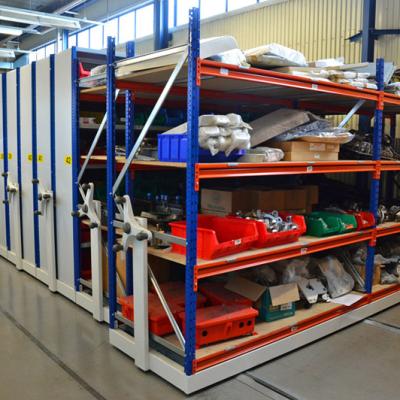
Essentially, hand-crank mobile racks are racks that can move back and forth on rails fixed to the floor. Instead of having to maintain an aisle between every pair of rack rows like in traditional static rack systems, businesses only need to open an aisle at the position where goods need to be retrieved. This shortens search time, saves space, and improves labor productivity. The hand-crank mechanism allows the operator to shift each rack through mechanical or electrically assisted drives, ensuring safety and ease of use.
In fact, mobile racks have long been applied in some sectors, especially in large libraries or in corporate document storage. However, in recent years, driven by the rapid growth of the manufacturing industry and the need for flexible goods management, hand-crank mobile racks are emerging as a significant trend. Not only found in conventional warehouses, this solution is also integrated into production lines to optimize the flow of raw materials, semi-finished, and finished products.
This article provides an overview of the trend of applying hand-crank mobile racks in the manufacturing sector, including their characteristics, benefits, practical examples, and future implementation trends.

A typical hand-crank mobile rack system comprises:
Hand-crank mobile rack systems offer flexibility in spatial layout and improve operational efficiency. Their user-friendly operation and the ability to easily adjust the width of aisles are prominent features that have quickly made this type of rack popular.

One of the greatest challenges in warehouse management is limited floor space, especially in urban or industrial zones where land costs are high. Compared to traditional static racks, hand-crank mobile racks can save up to 50% of aisle space because you only need to open the area you need to access, rather than maintaining multiple permanent aisles. As a result, businesses can optimize floor space, increase storage capacity, or allocate room for other activities.
By only opening the aisle where goods need to be retrieved, the travel time for warehouse staff is minimized. Additionally, if combined with barcodes, a Warehouse Management System (WMS), or other automatic identification methods, businesses can quickly locate items, boost labor productivity, and reduce errors.
Hand-crank mobile racks often come with safety features such as emergency stop buttons, blocking bars, and sensors to prevent collisions during movement. Moreover, the rack structure can be designed with enclosed or protective doors to avoid moisture, dust, or insects. Storing goods by rack rows also helps businesses manage and monitor quantities and product quality more easily.
Enterprises can design hand-crank mobile rack systems suitable for any type of floor plan, from small workshops to large storage facilities. Changing layouts, upgrades, or expanding rack rows is not overly complicated, because the rail and crank mechanisms can be installed in a modular fashion.
Many businesses are undergoing digital transformation and applying technology solutions such as QR codes, RFID, Autonomous Guided Vehicles (AGVs), or IoT to manage smart warehouses. Hand-crank mobile racks can integrate seamlessly with these platforms, as the rack system can automate aisle opening and send position data to the warehouse management server, thereby optimizing the entire order processing flow.
Electronic components demand high precision and must be protected against moisture and physical impact. An electronics factory in a High-Tech Park has employed hand-crank mobile racks to manage SMT (Surface-Mount Technology) components. Thanks to the space savings, they increased the capacity for components by 40% while ensuring static electricity safety and component quality through enclosed rack designs.
Pharmaceuticals and medical equipment require strict storage conditions regarding temperature, humidity, and systematic organization to avoid errors. A central hospital installed hand-crank mobile racks to store patient records and medications. As a result, document retrieval and drug dispensing times dropped by over 30%, and storage space increased significantly compared to static rack systems.
For bulky mechanical parts and automotive components, hand-crank mobile racks are designed with high load capacity and smooth movement. An automobile assembly company in a southern industrial zone invested in this system for their parts warehouse, cutting down warehouse rental costs and speeding up order processing, thus enhancing competitiveness.
Food products often have short shelf lives and require strict FIFO (First In, First Out) management. A hand-crank mobile rack system allows businesses to easily section storage areas, use barcodes to track and retrieve goods in the correct sequence. Notably, in cold storage, this solution saves energy because space is optimally utilized and doors are opened less frequently.


Today, manufacturing enterprises not only seek to optimize warehouse floor space but also aim to boost productivity, ensure worker safety, and maintain flexibility in goods management. Hand-crank mobile racks have emerged as a promising solution that significantly enhances storage efficiency in a highly competitive environment.
From saving space and improving operational performance to integrating well with modern technologies at a reasonable cost, hand-crank mobile racks are expected to continue thriving, meeting the increasingly stringent demands of the manufacturing sector. Successful implementation requires choosing a reputable supplier, properly identifying needs, and designing a rack system tailored to specific conditions.
In the future, as Industry 4.0 technology penetrates further into manufacturing and logistics, a fully “intelligent warehouse” may take shape—where hand-crank mobile racks interact with robots, Artificial Intelligence (AI), and IoT sensors to automate the entire goods management process. With proper infrastructure, staffing, and strategic planning, this solution can serve as a powerful springboard, increasing productivity and sustainable business efficiency.
0903422179 (Mr. Đạt)
0903412296 (Mr. Hiển)
0903434374 (Mr. Cẩm)
contact@giakelongquyen.com
contact@longquyen.com
79 Dao Tan Street, Ha Noi, Viet Nam
84-24-37260098; Fax: 84-24-32115955
Tay Mo Industrial Park, Tu Liem District, Ha Noi, Viet Nam
84-24-37643527; Fax: 84-24-37643767
 Kệ Selective Pallet – Giải Pháp Lưu Trữ Linh Hoạt Cho Kho HàngStackable Box Pallets - Increase Warehouse Space by 70%Automated Racking System Helps Improve Warehouse EfficiencyTrends in the Application of Hand-Crank Mobile Racks in ManufacturingHow Does Double Deep Pallet Racking Optimize Warehouse Space?Comparing Pallet Racking Types: Which Option is Right for You?